
 Plz Note: NEW HOST in 2014!
Our old webhost suffered a catastrophic meltdown in the fall of 2013 and we had to move to a new host.
 If something is missing, PLZ Email Charly. Thanks!
Charly’s Email address CHANGED in October, 2010
Due to the vast number of pages and documents posted on CharlyDMiller.com, only the
MAIN PAGES of this website have the NEW EMAIL ADDRESS:
 chas@novelholiday.com

NOTE FROM CHAS:
My original inspiration for developing and presenting patient communication training programs was a truly remarkable book: Patient Communication for First Responders and EMS Personnel. The author, Donald Trent Jacobs, Ph.D., Ed.D., was a speaker at the 1992 JEMS EMS Today conference in Albuquerque, New Mexico. So, I was able to meet him – becoming further inspired to provide this training.
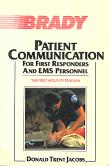 (My copy has “yellowed” with age!) |
|
section of Dr. Jacobs’ © 1991 text:
“Dr. Jacobs earned his doctorate in Health Psychology |
Much of “my” material is derived from, or based upon, Dr. Jacobs’ book. In fact, his text remains the ONLY, published, Emergency Patient Communication textbook that I know of. I will always be deeply grateful to Dr. Jacobs, for being the first to clearly identify WHAT “appropriate” patient communication IS, and how vitally important it is to victims of emergencies.
Although, his text became difficult to find in the mid-90’s, A NEW EDITION may someday be released!
I wholeheartedly recommend that you obtain a copy of it – whether the ORIGINAL book, or a new edition.
Patient Communication for First Responders and EMS Personnel
Author: Don T. Jacobs, Ph.D., Ed.D.
The first book to show the effect of healing suggestions during the first hour of trauma. These suggestions can be used to enable the patient to use their own healing potential to stabilized such autonomic nervous system functions as bleeding and blood pressure. This approach is endorsed by such notables as Norman Cousins. (Published Prentice Hall,1988.)
2006 Dispatchers Need The Info
This is a PDF file of the SLIDES for the program I presented at
The Nebraska Emergency Service Communications Association (NESCA)
conference in Kearney, on September 20th, 2006.
There is no “return” link to here from there. So, bookmark this page.

SAMPLE Interview Secrets Handout
Medication Questions Handout
In September of 1998, the EMS Internet Web Site, MERGInet.com began publishing a series of my Patient Communication articles. Although I did my best to write each article so that it “stands alone,” the Greatest Educational Impact is derived by reading ALL 12 installments, IN ORDER.
The Foundation of Patient Communication – Part 1
The Foundation of Patient Communication – Part 2
The Foundation of Patient Communication – Part 3
The Foundation of Patient Communication – Part 4
The Foundation of Patient Communication – Part 5
The Foundation of Patient Communication – Part 6
The Foundation of Patient Communication – Part 7
The Foundation of Patient Communication – Part 8
The Foundation of Patient Communication – Part 9
The Foundation of Patient Communication – Part 10
The Foundation of Patient Communication – Part 11
The Foundation of Patient Communication – Part 12
The SAMPLE interview mnemonic is a reasonably good mnemonic. And good mnemonics are truly handy to use, because they keep us from missing any steps or questions. Unfortunately, no core curriculum texts (and very few instructors) adequately train Prehospital or Inhospital emergency medical personnel precisely how to Interview people! This paper explains the “secrets” to better patient interview techniques related to obtaining a “SAMPLE” history.
This paper was originally posted here on January 14th, 2000.
This handout accompanied my SAMPLE Interview Secrets educational program.
Throughout medical history, even the most experienced care providers have been asking medication questions that yield incomplete information. (We have ALL been trained to ask these “bad” medication questions!) Incomplete information leads to medical assessment and treatment errors. This paper explains four basic questions that yield the most complete and accurate information about any patient’s medications.
This paper was originally posted here on January 6th, 2000.
This handout accompanied my Medication Question Secrets educational program.
This article marks the first in a series covering patient communication techniques and how emergency care providers can utilize these skills to improve patient care.
This page was originally published in MERGInet.com’s September, 1998 issue.
This installment explains the altered state of awareness that is experienced by every emergency patient (both medical and traumatic emergency patients), and how communication techniques can improve each patient’s response to care.
This page was originally published in MERGInet.com’s October, 1998 issue.
Just like almost everything else in medicine (or life), patient communication begins with the "ABC"s. This installment defines communication “ABC”s, and how using them can improve each patient’s response to care.
This page was originally published in MERGInet.com’s November/December, 1998 issue.
There are three steps to effectively using the ABCs of communication. This installment discusses these simple steps.
This page was originally published in MERGInet.com’s January, 1999 issue.
Emergency crisis brutally rips away a patient's Sense of Self-Control! Until we begin to restore that sense of control, the patient will only become more adversely affected by feeling the loss of it.
This page was originally published in MERGInet.com’s February, 1999 issue.
More techniques for speaking and acting in a manner that restores a patient's sense of control (Including the THREE MAGIC WORDS of EMS)!
This page was originally published in MERGInet.com’s March, 1999 issue.
The enormously successful technique of using explanations to repair loss of control anxieties.
This page was originally published in MERGInet.com’s April, 1999 issue.
The Three Divine Secrets to (and other information about) restoring a patient's sense of control with choices or by asking permission!
This page was originally published in MERGInet.com’s May, 1999 issue.
How offering choices and asking permission can actually assist in diagnosis and care decisions!
This page was originally published in MERGInet.com’s June, 1999 issue.
The Fourth Divine Secret is added to the list of secrets to restoring a patient’s sense of control.
This page was originally published in MERGInet.com’s July, 1999 issue.
The Evil “T-Word” – the first of two words that all care providers (in-hospital and prehospital) need to stop using!
This page was originally published in MERGInet.com’s August, 1999 issue.
The Evil “O-Word” – the second of two words that all care providers (in-hospital and prehospital) need to stop using!
This page was originally published in MERGInet.com’s September, 1999 issue.
REGARDING MATERIAL POSTED ON THIS WEB SITE:
If you have any intention, whatsoever, of reproducing anything posted on this web site,
Pul-lease go to theDISCLAIMER/COPYRIGHT PAGE
(Trust me – It’s not a huge problem! Just the usual technicalities.) Email Charly at: chas@novelholiday.com